

Thoracic Aortic Stent Graft System: Top Options for Aortic Aneurysm Repair
2026-10-10
When a thoracic aortic aneurysm demands intervention, the choice of stent graft system becomes a critical decision that shapes long-term outcomes. Yet with so many devices on the market, how do you cut through the noise? This guide spotlights the top options available today, highlighting what truly sets them apart in real-world practice. Among the names worth watching is INT, a brand pushing the boundaries of conformability and deployment precision. Whether you're an interventionalist refining your toolkit or a patient researching your path, understanding the nuances of each system can make all the difference when the stakes are highest.
Why Thoracic Stent Grafts Demand a Different Engineering Approach
The thoracic aorta is not simply a wider version of the abdominal segment. Its curvature, branch vessel origins, and continuous motion from cardiac ejection and respiration create a mechanical environment that punishes stiff or overly rigid devices. Engineers must design for cyclic loading, torsion, and longitudinal extension that would quickly fatigue a standard endograft.
Conformability and seal become intertwined in ways that don't apply below the diaphragm. A thoracic device has to hug the inner curve of the arch without kinking, while maintaining apposition against a wall that changes diameter and angulation with every heartbeat. This demands fabric architecture and stent ring geometry that distribute strain rather than concentrating it at fixed points.
The consequences of failure are also magnified. Migration, endoleak, or collapse in the descending thoracic aorta can compromise the left subclavian or carotid circulation, or lead to retrograde dissection. So material selection, radial force, and fatigue testing protocols must be tailored not just to hold a tube open, but to survive decades of asymmetric, pulsatile, and bending loads.
Graft Fabric and Frame Combinations That Influence Seal and Durability
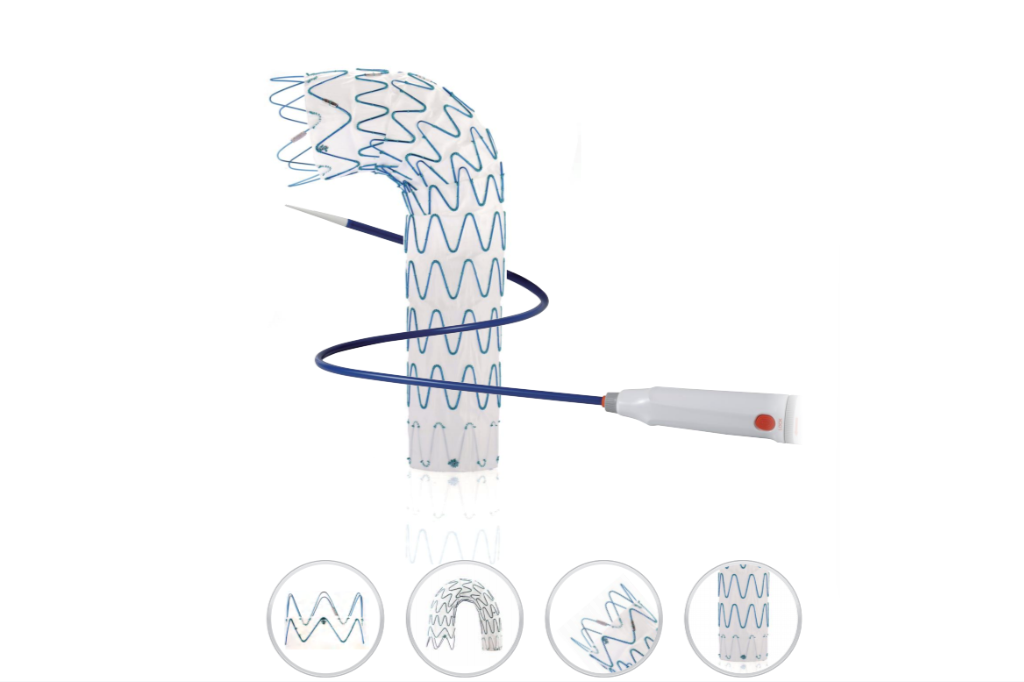
The interface between graft fabric and frame determines how evenly pressure distributes across the seal zone. Tightly woven polyester or ePTFE, when paired with a rigid frame, can create micro-gaps under cyclic loading that gradually compromise the barrier. A more compliant fabric, such as knitted polyester, absorbs dimensional shifts without separating from the frame, keeping the seal intact over repeated expansions.
Durability hinges on how the frame edges interact with the graft material. Sharp or unfinished frame struts abrade the fabric from the inside, leading to wear points that eventually develop into leaks. Rounded, polished edges combined with a fabric that has been pre-shrunk to match the frame’s final dimensions reduce this friction and extend the functional life of the device.
Combinations that allow slight relative movement between fabric and frame often outperform rigidly bonded pairs. A controlled slippage of one to two millimeters prevents stress concentration at the suture or weld points, which is where most failures begin. This balance between restraint and freedom of motion is what separates a short-lived seal from one that remains stable after years of pulsatile flow.
Deployment Systems Worth Comparing Before You Commit
It’s easy to fall for a deployment system’s demo, but the real test is what it does when a rollout goes sideways. Before you commit, set up three non-production environments and push a deliberately broken release through each one. Watch how long it takes to detect the failure, what signals you get, and whether the rollback is a one-click action or a manual scramble. That single drill often reveals more than a month of reading docs.
Don’t compare feature lists in isolation—compare the daily friction. Kubernetes can do almost anything, but running your own control plane across three availability zones is not a weekend project. Nomad is refreshingly simple until you need pod security policies or a service mesh. Managed platforms hide some of that pain, but they introduce their own limits around custom controllers, audit trails, and data residency. Ask not just “can it do X?” but “who gets paged when X breaks?”
A practical shortcut is to treat the evaluation like a bake-off. Give each candidate the same non-negotiable requirements: zero-downtime deploys, encrypted secrets, and a way to roll back across multiple clusters. Score them on how much custom glue you had to write. The system that needs the least glue tends to stay boring, and boring is exactly what you want in production infrastructure.
Anatomical Red Flags That Limit Endovascular Repair
Endovascular repair is far from a one-size-fits-all solution. Certain anatomical features quietly undermine the procedure's success, often forcing surgeons to reconsider an open approach. A short, angulated proximal neck—particularly one under 10 mm with heavy thrombus or a reverse taper—can compromise seal and lead to late type Ia endoleaks. Iliac arteries that are severely tortuous, calcified, or less than 7 mm in diameter pose a different challenge: access vessels may rupture or fail to accommodate the delivery system, even with advanced low-profile devices.
Beyond the classic criteria, overlooked details such as a conical neck with more than 20% diameter change over the first 15 mm, or a neck with a mural thrombus exceeding 2 mm in thickness, raise the risk of device migration. Similarly, a hostile iliac bifurcation with a narrow distal landing zone below 10 mm can force extension into the external iliac, sacrificing internal iliac perfusion. These red flags are not absolutes—they are thresholds where the margin for error thins.
In everyday practice, the most telling red flags are the ones found on the table, not just in imaging. A calcified femoral artery that resists sheath advancement, a proximal neck that balloons under balloon inflation, or an iliac limb that kinks despite relining—all signal that the anatomy is punishing the endograft. Recognizing these signs early spares the patient a failed repair and opens a clearer conversation about open surgery or hybrid strategies.
What Long-Term Imaging Reveals About Device Performance
Long-term imaging studies offer a window into how a device behaves once the initial calibration period fades. Early tests often capture a honeymoon phase where everything aligns with factory specifications. But as months pass, subtle drifts begin to surface. Sensor gain shifts, pixel response becomes uneven, and mechanical wear introduces alignment errors that were never visible in short-term evaluations.
The most striking finding is not a sudden failure but a slow degradation of contrast-to-noise ratio. Detector elements lose sensitivity at different rates, creating fixed pattern noise that mimics clinical findings in medical devices or defects in industrial inspection. Thermal cycling accelerates this, especially in portable systems. Repeated power cycles stress the readout electronics, and without periodic recalibration, the soft tissue contrast that was once crisp starts to blur into background haze.
Yet these longitudinal data also highlight an unexpected resilience. Devices that are used continuously, rather than intermittently, often show more stable performance because temperature and humidity remain within a narrow band. The takeaway for engineers is clear: design for the long haul, not the demo day. Include automated drift correction, schedule preventive maintenance based on actual usage patterns, and treat imaging performance as a living metric that needs ongoing attention.
Reintervention Rates Across Leading Stent Graft Families
When tracking long-term durability after endovascular aneurysm repair, reintervention rates often diverge more by device family than by operator experience alone. Registries and comparative cohort studies point to a spread of roughly 10–20% at five years, but the underlying reasons differ. Some platforms show higher early reinterventions due to type II endoleak management, while others accumulate late events tied to limb occlusion or migration. The Zenith and Endurant families, for instance, tend to cluster at the lower end of that range in several real-world analyses, whereas older-generation Excluder devices carried a higher burden before design refinements narrowed the gap.
Direct cross-trial comparisons remain tricky because definitions of clinically relevant reintervention vary. A sac expansion driven by endoleak may prompt one center to reline immediately and another to observe. Still, newer modular systems with lower-profile delivery and active suprarenal fixation have generally reduced late conversions and graft-related complications. The practical takeaway is that reintervention is not a single failure metric; it reflects an interaction between patient anatomy, device sizing, and surveillance intensity as much as the inherent performance of the stent graft family.
FAQ
Several devices have strong track records, including Medtronic's Valiant Captivia, Gore's TAG and Conformable TAG, Cook's Zenith Alpha Thoracic, and Terumo Aortic's RelayPro. The best option depends on patient anatomy, landing zone length, and access vessel size rather than any single brand being superior across the board.
When the aneurysm extends close to or involves the supra-aortic branches, a standard tube may not leave enough healthy aorta for sealing. In those cases, fenestrated or branched devices preserve flow to the innominate, left common carotid, or subclavian arteries. Custom-made or off-the-shelf branched grafts are increasingly used, though they require precise planning and more operator experience.
Inadequate iliofemoral access, extremely tortuous or calcified aortic anatomy, or a landing zone shorter than 15 mm can make endovascular repair unsafe. Active infection of the aorta or a connective tissue disorder like Marfan syndrome also pushes many teams toward open surgery, since stent grafts do not address the underlying aortic wall weakness.
A high-resolution CT angiogram of the chest, abdomen, and pelvis is the core study. It shows aortic diameters, branch vessel involvement, thrombus burden, and access vessel caliber. Many centers also use 3D reconstruction software to simulate graft deployment and choose optimal C-arm angles for the procedure.
They are frequently used for complicated type B aortic dissections, especially when there is malperfusion, rupture, or rapid aortic expansion. The goal differs from aneurysm repair: in dissection, the stent graft covers the primary entry tear to redirect flow into the true lumen and promote false lumen thrombosis. For uncomplicated dissections, medical therapy remains first-line.
Endoleaks, particularly type I and type III, are the main concern because they can lead to sac pressurization and rupture. Type I leaks often need additional ballooning, extension cuffs, or conversion to open repair. Spinal cord ischemia is another serious risk, so teams use prophylactic cerebrospinal fluid drainage for high-risk patients with long aortic coverage.
Active fixation with proximal bare stents or barbs, low-profile delivery systems, and better conformability to the aortic arch have all helped. Newer fabrics are less porous and more resistant to wear. Some devices now incorporate preloaded catheters or modular branches, which simplify complex arch and thoracoabdominal repairs.
Conclusion
Choosing a thoracic aortic stent graft system goes beyond catalog specs. The unique mechanical demands of the thoracic aorta—constant motion, high pulsatile flow, and curved arch geometry—force engineers to move past simple tubular designs. Leading systems pair low-profile woven polyester or ePTFE fabrics with nitinol or stainless steel frames that balance radial force against chronic outward pressure. Seal and durability hinge on how those materials interact at the proximal and distal landing zones. Before committing, it pays to compare deployment mechanisms: some use tip capture for controlled release, others rely on pin-and-pull or rotational triggers that shape precision in tight arches.
Anatomical red flags, such as excessive neck angulation, short landing zones, mural thrombus, or narrow iliac access, still limit endovascular repair despite newer tapered and branched configurations. Long-term imaging from CTA and MRA tells a more honest story than bench testing—showing subtle fabric wear, frame fractures, endoleak persistence, and sac regression. Reintervention rates vary across the leading stent graft families, often separating devices that maintain stable proximal seals from those needing secondary relining or embolization. The best option ultimately depends on matching the graft’s mechanical behavior and delivery style to a patient’s arch morphology and follow-up reality.
Contact Us
Contact Person: Jeffrey
Email: [email protected]
Tel/WhatsApp: 86-0633-2230056
Website: https://www.sd-intmedical.com