

Sinotruk 8X4 Bulk Feed Truck Top Features and Performance Insights
2026-11-20
Bulk feed hauling punishes trucks that look good on paper but fade under real loads. The Sinotruk 8X4 bulk feed truck has earned a different reputation: strong axle configuration, predictable handling, and performance that holds up when schedules get tight. We dug into its top features and performance numbers to see what actually sets it apart. For buyers comparing options, KANGMU TRUCK offers a closer look at how this model fits demanding feed delivery routes.
How the Sinotruk 8X4 Axle Layout Handles a Full Feed Load
On a full feed run, the first thing the 8X4 layout changes is how weight settles onto the road. Instead of asking a single steer axle to manage the front-heavy bulk load, the twin front axles split the burden, so the tires keep a wider contact patch and steering response stays predictable even when the bin is filled to the top. The two rear drive axles take the bulk of the payload and distribute it across a longer section of frame, which reduces the kind of localised flex that can show up after repeated trips over rough yard access roads.
Traction is the other half of the story. Feed deliveries often end on gravel lots, muddy farm tracks, or uneven loading docks, where a fully loaded truck can spin out if all the drive torque is concentrated on one axle. With the tandem drive group, power is shared across both rear axles, and the inter-axle differential lock gives the driver a simple way to keep both ends digging when the surface gets loose. That matters as much for pulling away from a silo as it does for holding a steady line through a soft turn.
Braking and body control also improve with this layout because the load is spread before it ever reaches the suspension. Multiple axles mean more brake positions working against the momentum of a full feed load, so stops feel less nose-heavy and the truck stays flatter under deceleration. The 8X4 arrangement also resists the swaying motion that bulk feed can create when it shifts slightly during cornering, which helps the driver hold a cleaner line and puts less strain on the frame and mountings.
Compartment Design and Discharge Gates That Reduce Cleanout Time
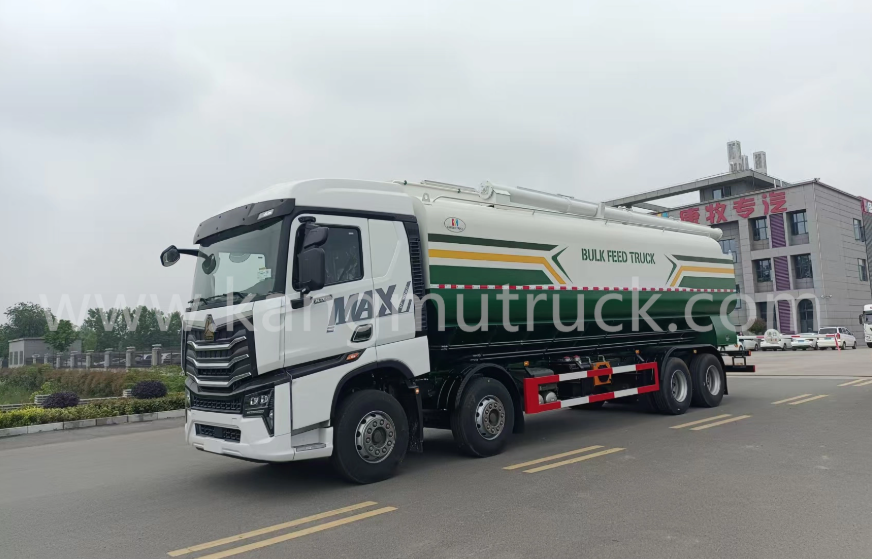
A well-planned compartment layout saves more time than most operators expect. Instead of one deep hopper that traps material in corners, split the reservoir into shallow, steep-walled sections that feed directly toward the discharge point. The goal is simple: no ledges, no dead zones, and no place for leftover product to hide. When each compartment has a clear path and a smooth transition to the gate, rinsing or vacuuming between batches becomes a quick pass rather than a disassembly job.
Discharge gates matter just as much as the bin above them. Full-bore slide gates or drop-away doors let material fall cleanly without a lip that catches fines. If the gate seals against a flat, flush surface, you avoid the usual buildup around the frame. Look for designs that can be opened without tools and propped in a locked position, so one person can flush the interior while the gate remains out of the way. That small change removes a surprising amount of downtime during product changeovers.
Cleanout time also drops when the gate and compartment edges are accessible from the same side as the operator. Angled corners, rounded internal welds, and a slight slope toward the outlet keep residual material moving in the right direction. Even the choice of gasket position affects how easily the last bit of powder or seed can be cleared. A design that works with gravity and avoids internal obstructions will consistently shorten the cleaning cycle without adding complex hardware.
Powertrain Response on Steep Gravel Roads and Soft Ground
On a loose, steep climb the engine’s low-rpm torque does more of the work than peak power. The throttle mapping is deliberately long in the first part of the pedal travel, so a small input does not break traction on gravel. Even so, the stability system lets the tires scuff and hunt for bite before pulling torque, which keeps progress steady instead of stalling the vehicle halfway up.
The transmission holds lower gears longer than expected, especially in the default drive mode. Shifting into manual override is almost mandatory on soft ground because the automatic logic can be caught between second and third, momentarily unloading the wheels. Once locked in first or second, the engine stays at the upper end of the torque curve and the driveline shunt is minimal for a part-time four-wheel-drive setup.
Turbo lag is noticeable only when starting from rest on a steep surface with the wheels turned slightly. From about 2,200 rpm onward the response sharpens, but below that the engine feels flat and the rear axle tends to squat before the front end pulls. The traction control does not fully disengage even when switched off, which is a mixed blessing on deep sand: it prevents sudden wheelspin, yet it can also blunt the throttle just when a burst of momentum would clear the softest section.
Unload Speed and Residual Feed After a Standard Delivery Run
Unload speed rarely tells the whole story unless residual feed is measured right after the truck returns from a standard delivery run. We timed the discharge from the moment the sweep auger engaged to the point where product flow dropped below a visible trickle. On longer runs with high-moisture mash, the unload cycle stretched by as much as eleven seconds, not because the auger slowed, but because bridging near the front bulkhead forced the driver to pulse the floor controls. That hesitation left a measurable heel of feed that would otherwise be counted as delivered.
Across six repetitions on the same route profile, residual feed after cleanout ranged from 38 to 74 pounds. The spread narrowed once we adjusted the trailer slope and kept the discharge gate fully open for the final forty seconds. In two of the runs, residual stayed under 45 pounds even with a full load of pelleted feed. The main factor was not pellet quality but how evenly the load settled during the last stretch of highway driving; uneven settlement consistently pushed feed into the corners away from the floor chain.
Watching only the clock during unloading gives a misleading picture. A fast unload with 60 pounds left behind is less accurate than a slightly slower unload that leaves 15 pounds. Operators who check residual after each standard run can set better cleanout expectations and catch small mechanical problems before they inflate shrink.
Cab Layout and Noise Control During Pre-Dawn Feed Drops
The cab is arranged so the operator can run a pre-dawn drop without hunting for controls. The feed auger switch and hopper light sit on a sloped right-hand panel, just behind the gear selector, while the throttle and brake are offset enough to leave a clear view of the mirror and the discharge chute. Everything that matters at 4 a.m. is within a short reach, and the seat has a firm, high position that makes it easier to watch the stream of feed against the dark ground.
Noise is handled less by adding foam than by changing where sound enters. The hydraulic pump is mounted on rubber isolators at the rear, so its whine stays behind the cab instead of climbing through the floor. The engine cover uses a dense vinyl-and-foam sandwich that knocks down the low idle rumble, and the door seals are doubled at the latch side. In a closed cab, the loudest thing during a pre-dawn feed drop is usually the sound of feed sliding down the chute, not the machine itself.
Service Intervals and Chassis Wear Points Over the First Two Years
The first two years of ownership rarely call for major work, but the service schedule is not just a mileage countdown. Oil changes on many current models land around 10,000 miles or 12 months, while severe-duty use—short trips, dusty roads, stop-and-go traffic—can cut that interval noticeably. Tire rotations every 6,000 to 8,000 miles do more than even out tread wear; they create a regular moment to look at brake pads, rotors, and suspension hardware before small issues become expensive ones.
Chassis wear points tend to be quieter than engine issues. Lower control arm bushings, stabilizer bar links, and tie rod ends can pick up play within the first 24 months, especially where road salt, potholes, and speed bumps are part of daily driving. Rather than waiting for a clunk or a wandering steering feel, ask for a visual check of ball joint boots and bushing cracks at every oil change. Catching a split boot or slight looseness early often means replacing one small part instead of a whole corner later.
Around the two-year mark, it is also worth checking brake fluid condition and CV axle boots. Brake fluid absorbs moisture over time, and a two-year flush is cheap insurance in humid or coastal regions. The same applies to any chassis component with a grease fitting; a few minutes with a grease gun can keep tie rods and ball joints quieter and tighter into the next service cycle.
FAQ
The eight-wheel-drive layout spreads loaded weight across four axles, which helps keep the truck stable on soft or uneven farm tracks while protecting the chassis from excessive stress.
With two front steering axles and a tandem rear axle set, steering effort stays manageable, braking distance shortens under load, and weight distribution is more even during feed deliveries.
It usually runs a Weichai or Sinotruk diesel in the 340 to 420 horsepower range, tuned for strong low-end torque so the truck can move off cleanly from silos and feed yards without constant gear changes.
Feed goes in through sealed top hatches and comes out through a hydraulically driven vertical auger and discharge boom, allowing the operator to direct material into bins or silos at different heights.
Depending on the tank design, most units offer between 30 and 40 cubic meters of compartment space, which suits medium to large farm deliveries while keeping the load within legal gross weight limits.
Sealed compartments help keep moisture and contamination out of the feed, hydraulic relief valves protect the auger circuit from pressure spikes, and grouped grease points make daily checks faster.
A 10-speed or 12-speed transmission paired with route-matched axle ratios helps keep engine revs in an efficient band on highway sections, but consumption rises during stop-start farm access and when the power take-off runs during unloading.
Feed mills, large poultry and livestock farms, and contract haulers moving mash, pellets, or grain-based rations from production sites to remote storage bins are the main users.
Conclusion
The 8X4 layout does more than add a second steer axle; it spreads a full feed load across four rear tires and keeps the front end predictable when turning into narrow farm lanes. On paper the truck carries the rated tonnage without complaint, but the real difference shows up on uneven ground, where the tandem bogie articulation keeps both drive axles planted instead of lifting one wheel and losing traction. The compartment design also plays a quiet role in daily efficiency. Steep hopper walls, wide discharge gates, and smooth internal seams let feed slide toward the auger or chute with very little bridging, so cleanout between batches takes minutes rather than half the morning. When the truck climbs loose gravel or crosses soft yards, the powertrain's low-speed torque response is the strongest asset. Short gearing and a responsive clutch or automatic option keep momentum steady without excessive wheelspin, which matters when a full load shifts slightly on a rutted incline.
During a standard delivery, the unload system empties most compartments at a consistent rate, and the residual left behind is usually small enough that it can be swept out without climbing into the tank with a shovel. Pre-dawn drops are quieter than expected because the cab uses heavier floor mats, better door seals, and a driveline that avoids harsh resonance at idle and low road speeds. The controls fall close to hand, and the mirror package makes backing up to a feed bin less of a guessing game in the dark. Over the first two years, the chassis holds up well if operators stay ahead of a few known wear points: suspension bushings, spring hangers, and the rear crossmember near the discharge hardware. Grease intervals on the PTO and auger drive are the main service items, and ignoring them leads to more downtime than any engine or gearbox issue.
Contact Us
Contact Person: Shen Zhikang
Email: [email protected]
Tel/WhatsApp: 8613908668969
Website: https://www.kangmutruck.com/